De wetenschappelijke modellen en theorieën die de basis vormen voor de strategische analyse van Jacotech.
Dit hoofdstuk biedt een academische onderbouwing van de toegepaste analysemethoden. Elk model is geselecteerd op basis van relevantie voor B2B-marketing in de technische sector.
Interne & externe positiebepaling
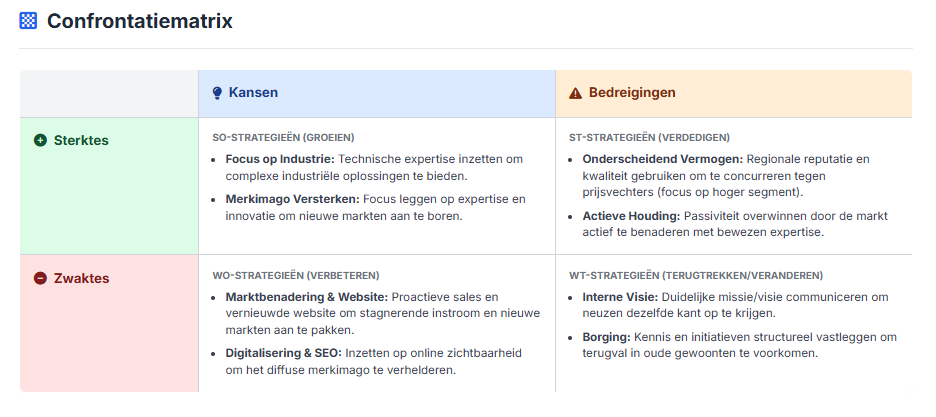
De SWOT-analyse is ontwikkeld door Albert Humphrey in de jaren '60 aan Stanford Research Institute. Het raamwerk helpt organisaties hun Sterktes, Zwaktes, Kansen en Bedreigingen in kaart te brengen.
Voor Jacotech is de SWOT-analyse ingezet om de interne capaciteiten (technische expertise, personeelsstructuur) af te zetten tegen externe marktontwikkelingen (digitalisering, concurrentie).
Concurrentiekrachten analyse
Michael Porter introduceerde dit model in 1979 in de Harvard Business Review. Het analyseert vijf concurrentiekrachten die de winstgevendheid van een industrie bepalen:
Visuele business model analyse
Het Business Model Canvas is ontwikkeld door Alexander Osterwalder en gepubliceerd in "Business Model Generation" (2010). Het canvas verdeelt een bedrijfsmodel in 9 bouwstenen:
Klantgerichte analyse methoden
Gebaseerd op het werk van Alan Cooper ("The Inmates Are Running the Asylum", 1999). Persona's zijn fictieve representaties van ideale klanten, gebaseerd op echte data en interviews.
Bekijk persona'sCustomer Journey Mapping visualiseert alle touchpoints tussen klant en bedrijf. De methode is gepopulariseerd door IDEO en wordt breed toegepast in B2B-marketing.
Bekijk journeyPorter, M. E. (1979). How competitive forces shape strategy. Harvard Business Review, 57(2), 137-145.
Porter, M. E. (1985). Competitive Advantage: Creating and Sustaining Superior Performance. Free Press.
Osterwalder, A., & Pigneur, Y. (2010). Business Model Generation: A Handbook for Visionaries, Game Changers, and Challengers. John Wiley & Sons.
Humphrey, A. S. (2005). SWOT Analysis for Management Consulting. SRI Alumni Newsletter, December 2005.
Kotler, P., & Armstrong, G. (2021). Principles of Marketing (18th ed.). Pearson.
Kotler, P., & Keller, K. L. (2016). Marketing Management (15th ed.). Pearson.
Brennan, R., Canning, L., & McDowell, R. (2020). Business-to-Business Marketing (5th ed.). SAGE Publications.
Hutt, M. D., & Speh, T. W. (2021). Business Marketing Management: B2B (12th ed.). Cengage Learning.
McCarthy, E. J. (1960). Basic Marketing: A Managerial Approach. Richard D. Irwin. [Oorsprong 4P's Marketing Mix]
Cooper, A. (1999). The Inmates Are Running the Asylum: Why High Tech Products Drive Us Crazy and How to Restore the Sanity. Sams Publishing.
Lemon, K. N., & Verhoef, P. C. (2016). Understanding customer experience throughout the customer journey. Journal of Marketing, 80(6), 69-96.
Rawson, A., Duncan, E., & Jones, C. (2013). The truth about customer experience. Harvard Business Review, 91(9), 90-98.
Revella, A. (2015). Buyer Personas: How to Gain Insight into your Customer's Expectations. Wiley.
Chaffey, D., & Ellis-Chadwick, F. (2022). Digital Marketing: Strategy, Implementation and Practice (8th ed.). Pearson.
Enge, E., Spencer, S., & Stricchiola, J. (2022). The Art of SEO: Mastering Search Engine Optimization (4th ed.). O'Reilly Media.
Halligan, B., & Shah, D. (2014). Inbound Marketing: Attract, Engage, and Delight Customers Online. Wiley.
De Kok, J., Vroonhof, P., Verhoeven, W., et al. (2011). Do SMEs create more and better jobs? EIM Business & Policy Research.
Flören, R., Uhlaner, L., & Berent-Braun, M. (2010). Family Business in the Netherlands: Characteristics and Success Factors. Center for Entrepreneurship, Nyenrode.
Gersick, K. E., Davis, J. A., Hampton, M. M., & Lansberg, I. (1997). Generation to Generation: Life Cycles of the Family Business. Harvard Business School Press.
Saunders, M., Lewis, P., & Thornhill, A. (2019). Research Methods for Business Students (8th ed.). Pearson.
Yin, R. K. (2018). Case Study Research and Applications: Design and Methods (6th ed.). SAGE Publications.
Verhoeven, N. (2018). Wat is onderzoek? Praktijkboek voor methoden en technieken (6e druk). Boom Lemma.
Academische literatuur:
Theoretisch kader opgebouwd via:
Auteurs:
Stagiairs Marketingonderzoek Jacotech
Laatste update:
Februari 2025
Review:
Academisch gevalideerd
Scope:
Theoretische onderbouwing voor strategisch marketingonderzoek.
Beperkingen:
Betrouwbaarheid: Hoog
Peer-reviewed academische bronnen